

Sighting in your rifle is one of the most crucial steps for ensuring accurate and consistent shots. This step-by-step guide will walk you through the process. Here’s what you’ll all need:
- Rifle
- Scope: Properly mounted on your rifle
- Ammo: The same type and brand you plan to use for hunting or target shooting. Weatherby recommends using factory Weatherby ammunition.
- Rest: Stable shooting rest, bipod, or sandbags to eliminate human error
- Targets: Paper targets with a clear aiming spot
- Rangefinder: To measure distance to target
- Tools: Screwdriver/Allen wrench for scope adjustments, depending on your scope
- Eye and ear protection
- Safe backstop
- Mount the Scope Properly
Ensure that your scope is securely mounted and leveled. A loose or improperly mounted scope will lead to inconsistent accuracy. Refer to your scope and rifle manuals for specific mounting instructions. If you need help mounting your scope, a gunsmith or gun ship will be able to help.
- Bore Sighting
Bore sighting is a good way to get your initial shots on paper, saving you time and ammunition.
- The Old Way
Remove the bolt from your rifle, look directly through the bore of your rifle at the target and align your rifle with the center of your target. Without moving your rifle, adjust your scope’s windage and elevation turrets until the reticle’s crosshairs are aligned with the bullseye.
- Tools for Bore-sighting
If you have a laser or other bore sighter (Collimator type), insert the bore sighter into the muzzle and then adjust your scope’s turrets until the reticle aligns with the laser dot or crosshair/grid on the target.
*NOTE*
Bore-sighting is only good enough to get you on a paper target at about 25 yards, this should not be considered sighting in or “zeroing”.
- Set up your Shooting Position
Choose a stable shooting position. A bench rest is ideal for sighting in. Ensure your rifle is stable and pointed safely downrange towards your target.
- Choose your distance
The most common distances for sighting in a hunting rifle are 50 and 100 yards. For initial sighting in, starting at 25 yards can be helpful, especially if you skipped bore sighting, to ensure you hit the paper
5.) Take Your First Shots (25 Yards)
Fire one shot, aiming precisely at the bullseye. Observe where the bullet impacts the target.
- Adjust your scope
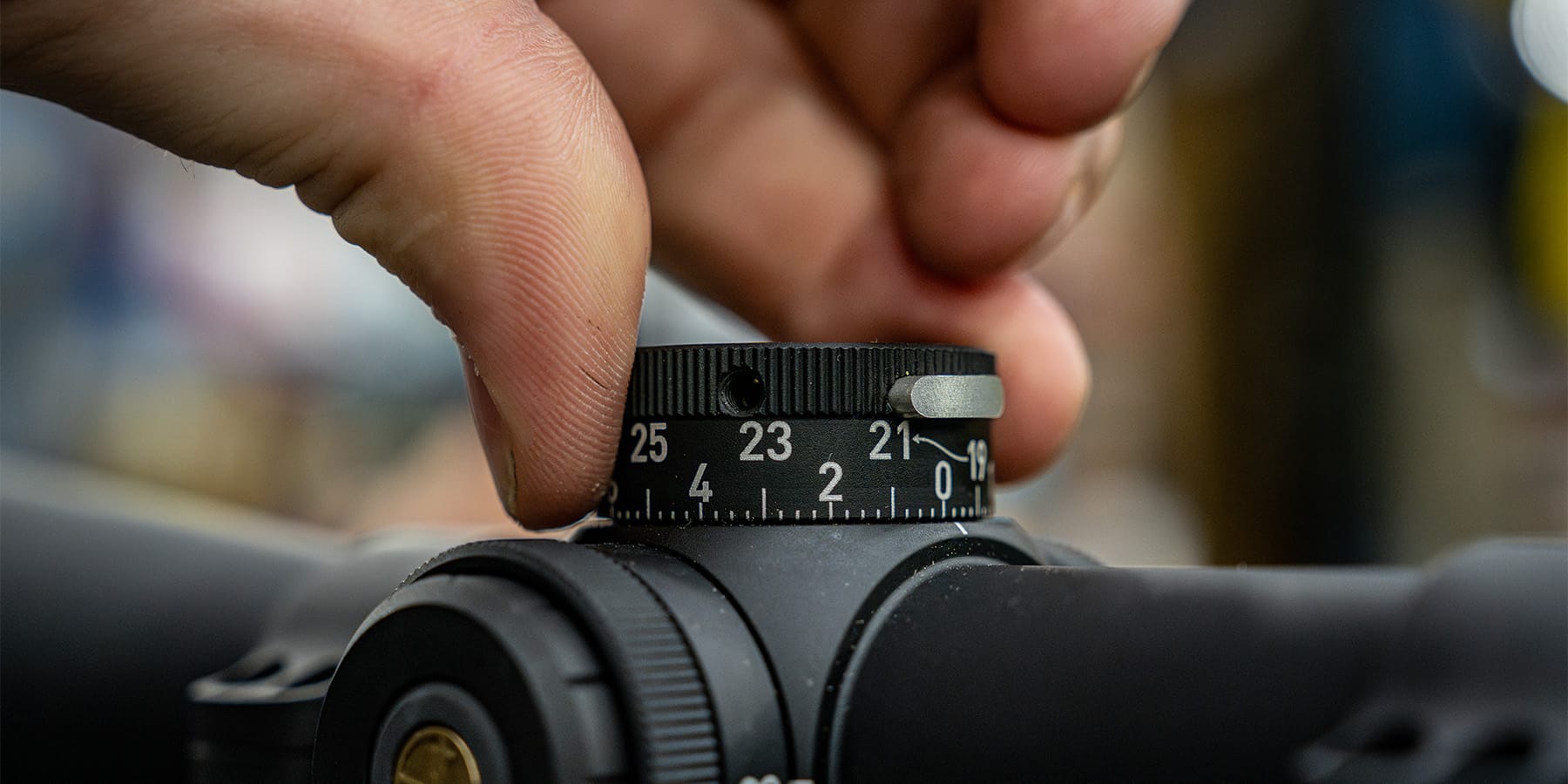
Your scope’s turrets will have markings for “clicks”. Each click moves the point of impact a certain amount at a given distance.
For Example: A common adjustment is ¼ MOA (Minute of Angle) per click, meaning at 100 yards, one click moves the impact ¼ inch. At 25 yards, ¼ MOA would move the impact 1/16 inch. Hold the rifle in your shooting position and aim at the same point of aim that you just fired at. While holding this position do not move the rifle, and adjust your scope so the reticle moves to where your shot just hit. Fire another shot and repeat the adjustment process until you are consistently hitting the bullseye at 25 yards.
6.) Move to Your Desired Sighting Distance (100/200/300 Yards)
Once you are accurate at 25 yards, move your target to the primary sighting distance.
- Fire a group of three shots, aiming precisely at the bullseye. A group helps identify consistency and average point of impact
- Measure the distance from the center of your group to the bullseye
- Adjusting the scope: Remember the “click” values will have greater effect at longer distances. If your scope is ¼ MOA per click, then at 100 yards each click moves the point of impact ¼ inch.
- Calculate the number of clicks needed to bring your group to the bullseye
- Example: If your group is 2 inches low and 1 inch left at 100 yards with a ¼ MOA scope:
- Elevation: 2 inches (¼ inch per click) = 8 clicks UP
- Windage: 1 inch (¼ inch per click) = 4 clicks RIGHT
- Make the adjustments and fire another group of three shots to confirm
7.) Fine-Tuning and Confirmation
Continue to fire groups and make small adjustments until your rifle is consistently hitting the bullseye at your desired sighting distance. A good sighting will result in tight groups on the bullseye.
Important Considerations
Always use the same type and brand of ammunition you plan to use in the field. Different ammunition can have different points of impact. Practice consistent shooting fundamentals (breathing, trigger control, steady hold, etc.) Wind, temperature, and humidity can affect bullet trajectory. When sighting in, try and choose a day with calm, cool conditions. The first shot from a cold barrel can sometimes hit slightly differently than subsequent shots. If this is a concern, consider this when practicing or hunting. Allow your barrel to cool off between every 3 round group.
By following these steps, you can effectively sight in your rifle with a scope, try practicing in the positions that you are likely to fire in during hunting. Depending on your position, you may find that you want to change your scope to accommodate how you intend to use your rifle in the field. Most people are shooting off of a bipod, kneeling, or another position, not off sandbags on a bench like at the range.
Written by: Caleb Conn – Customer Service and Custom Shop Manager
Leave a Reply